Powered by Blogger.

Home

Local listed companies dabbling in the share market!

Thursday, May 18, 2006

Dedicated to boyplunger.

I do strongly agree with you that investors should be very prudent if they see the listed company dabbling in the share market.

When we see 'marketable securities' in the balance sheet, we, the minority investor is really at risk for the following reasons:

1. what types of marketable securities are we talking about?

The term marketable securities is simply so vague. So what kind of marketable securities are we talking about?

Bonds? What kind of bonds? What if it is a junk bond that is tanking?
Unit trusts? What kind?
Stocks? What kind of stocks? Investment grade stocks or speculative stocks?

2. Who is making the investing decisions?

Fund managers? Who? And what sort of investments are we talking about?
Or are the management/owners on a DIY? That's even worse. What divine skills do they have?

3. Transparency.

There is simply no transparency involved, and everything is simply based on blind faith that such investments should generate some sort of income. And there is no way the minority investor can be sure if the management/owner of the listed company is abusing the company's funds to buy shares in another listed company for personal vested interests or reasoning.

4. Management focus.

Once they dabble in the stock market, the management/owner focus is being diverted. How could the minority investor expect the management/owner to remain focus on the core business when they are burdened with the extra responsibility of ensuring good results from their investment?

Read more...

ROI on Yi-Lai: Part VI

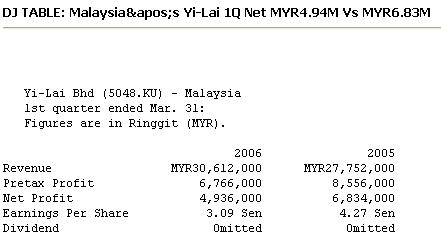
Yi-Lai just announced its 2006 Q1 earnings. (past blog postings on it can be found here: Part I , Part II , Part III , Part IV , Part V )


Yes, the net earnings were pretty low. And some would deem this as a huge disappointment. But then given the business economics of the industry during this earnings period, wasn't it expected? Two issues mentioned before (see : part-iii ), stiffer competition and higher cost of production stood out and it kept Yi-Lai's profits down. Oh yeah, I have to note that its sales revenue did increase.

And this was what the company management had to say in their earning notes.

  • For the current quarter under review, the Group recorded a higher turnover of RM30.6 million compared to RM27.8 million for the corresponding quarter in 2005 whilst profit before tax was RM6.8 million compared to RM8.6 million for the corresponding quarter in 2005. The lower profit before tax for the current quarter despite higher sales was due mainly to lower selling price as a result of stiffer competition and higher cost of production

Now on the positive note, Yi-Lai's cash flow was extremely healthy. Cash grew by 5.415 million for the quarter, which is something like DIGI, after the adjustment for non-cash item, such as depreciation charges, the piggy bank cash grew more than the reported earnings. And in Yi-Lai's case, the positive cash flow was a huge relief because Yi-Lai's recent capital expansion saw drastic cash depletion in its piggy bank ( the depletion of piggy bank cash was mentioned in part-ii. )

Piggy bank cash is back up to 53.613 million (no debts) versus 48.198 million a quarter ago. ( Ze piggy bank cash grew 5.415 million - yeah some folks just loved to see ze piggy bank cash grow and grow and grow.).

So two clear and present issues.

Remember the issue of it's the business that counts?

Well, Yi-Lai's business is struggling in the current tough business environment. The tough business environment is hurting Yi-Lai's profits. Make no doubt about it.

How concern would you be on this issue? How worried are you that Yi-Lai's earnings is hurting?

However, the balance sheet is top draw. Another rarity since we are witnessing an extremely healthy growth in the cash flow despite the tough business environment. It's highly commendable what the management is achieving during current times..

How brown cow?

Oh, Yi-Lai's final dividend goes ex on 1st June 2006.

Read more...

eB Capital II

Wednesday, May 17, 2006

Boyplunger raised the following issue on eB Capital.

  • I noted Redtone Technology Sdn Bhd has been accummulating EB Cap. Currently owning about 1.9m or 7% -8%.

    Why is Redtone buying the shares of this company? That is interesting. Did i miss out something on the company's history.

Yes, I do understand that Redtone International has been buying shares into this company.

Why is RedTone buying shares into a company that has real problem in making a profit?

I have no idea.

And yes, I do understand your thinking rational. Because the justification is if RedTone International is willing to buy shares into the company, surely there must be something in the company that RedTone sees as value. And surely no sane company would want to buy a company if there is no profit to be made. Right?

Hence, the argument is of course, perhaps one should follow and mimmick what RedTone does!

But if that is the case, isn't one implying that when one company or one individual purchases a share of another company, the buyer(s) reasoning to buy the share is always correct?

But do we or would we ever know the true motives or intentions in such share purchases? Would we ever have the privilege to evaluate their reasonings in their share purchase? If no, then aren't we making one huge assumption, which is the buyer(s) of the share(s) is always deemed correct?

Can such strategy go wrong?

Let me give some examples on what could go wrong.

Take the series of past postings on Karensoft. Well, the boss has always been constantly buying back shares in the company. So is the boss deemed correct in his actions? Well as everyone is well aware, Karensoft has just been re-classified as the first GN3 stock in the Messdaq listing. Which is rather dead serious since this classification states that Karensoft financial health is in a utter dire straits. So was there 'value' in the share purchase? Or perhaps the boss was buying for personal reasoning, which sadly is the 'value of being a listed stock'. So if one had followed Karensoft boss actions in the market, how then? See the danger?

Or how about the infamous purchase of a controlling stake in the huge congolomerate, DRB-Hiccom? How much was the share purchase back then? Wasn't it around 3.50 or so? Ahh.. I am sure that you are aware that some argued that because since the controlling stake was sold at such a high price valuation, then surely there must be value in the stock since the stock was selling around 2.00 back then. And what's the price of DRB-Hiccom today? Would a follow you, follow me strategy work in this case?

On the other hand, there were success stories in stocks like Transmile.

Ah, I am sure you understand what I am trying to say.

There's simply no gurantees in such strategy.

Sometimes it works but sometimes it can be dead wrong.

So how?

What's the best gauge?

Look at eB Capital.

eB Capital supposedly specialises in wireless broadband technology.

There'e 2 things one can gauge it on since it's listing. Look at these past compilations I had made on EB Capital .

The first news clip.

  • With a current local market share of 0.54% in terms of broadband subscription, more efforts would be devoted to marketing its products and services to enlarge its share, he added.
    Meanwhile, eB Capital's historical earnings demonstrate its strong growth.
    The company registered a pre-tax profit of over RM1mil last year and an after-tax profit of RM560,000.
    Revenue increased to RM8.3mil in 2004 from RM2.5mil in the preceding year

And the next article...

  • Wireless Internet broadband provider eB Capital Bhd (eBCap) expects its subscriber base to grow in multiples of 10,000 over the next two to three years as it embarks on an aggressive recruitment drive after its listing on Mesdaq.

See how b4 listing, eB Capital boasted about its great potential and its track record.

After listing, eB Capital showed it true self.

How do you value such a company?

Secondly, take a look at eB Capital last reported earnings. Do you like what you see?

If you don't then... should you be bothered with what RedTone does?

And if I have to guess, perhaps RedTone wants to go into the wireless broadband industry.

By the way, based on current price of 1.70, do you reckon that eB Capital business is worth what the market is pricing it?

Read more...

EB Capital

Firstly, I noted that this company had just received ze yellow card from the SC. Oops! Too much footie in me fried brain cellls! I meant EB Capital got ze UMA (Unusual Market Activity) from Bursa today, in which EB Capital replied in the following manner:

  • There is no corporate development relating to the eB Capital Group's business and affairs that has not been previously announced that may account for the unusual market activity save for the appointment of Aseambankers Malaysia Bhd on 16 May 2006 for the Company's Proposed Bonus Issue of 12,453,500 New Ordinary Shares of RM0.10 each in eB Capital ("eB Capital Shares"), to be credited as fully paid-up, on the basis of one (1) new eB Capital Share for every two (2) existing eB Capital Shares ("Proposed Bonus Issue")
Ah... so I decided to look at how the share was doing.


WoW!!!!

My oh my!

1.70??

Looks like this bugger has been stir-fried sunny side up!!!

Know why I am saying this? This is because I do remember that I had blogged on EB Capital b4.

In the blog posting, Oh Mess-Daq, I wrote the following on EB Capital:

<<==>>

Listed 2nd Aug 2005.

Yesterday I saw this bugger's quarterly earnings.

Sales Revenue: 1.802 million
Net loss: 1.064 million!!!

First
quarterly earnings (reported on Nov 2005 ) after being listed and EB Capital reports a net loss!

Imagine a horsie horse in a cup race. The bell rings and the horse stumbles, throwing the jockey off the horsie. How? Out off the gates and already no hope liao!!

Disgusting or not?

You tell me lah.

And worse still, this EB Capital losses is at operating level and the company is net debt.

And lagi worse still for EB Capital, based on yesterday's closing price, EB Capital market capital is worth some 21.4 million.

And lagi, lagi worse still.. just imagine if the bossie owns 13% of this stock. This means the bossie is worth some 2.78 million based on his shares value in the market.

You tell me lah.... how come sky NO eyes one?

So, so easy to be a million hair ar?
So, so easy to be kaya raya!!

Sigh!

And lagi, lagi, lagi worse... just how did such company got listed?

Mana tu QC?

Well, i dunno but u guys and gals but muah is certainly pleased to read that SC is aware of this issue and is enforcing stricter rules.

Comeon... SC let's kick some butt!!!!!!

But there are some who are sceptical.

Will it really help?

I dunno... but... at least the very first small step is being made to rectify this issue.

I shall keep my faith... for now.

<==>

Has my opinion changed?

Heck NO!

Came Feb 2006, EB reported its earnings. Which it had to ammend and ammend. And finally on March 2nd 2006, it announced its final ammended
quarterly earnings. And needless to say EB Capital states it loss 221k for that quarterly earnings. But somehow, it states it made 109k for its first fiscal year since listing.

But wait a minute.

Come 27th April, it boldly announced that there was a
variance between audited and unaidted results. To cut it short, EB Capital actually lost 342k for the fiscal year!!

How could such a rotten stock be listed in a stock exchange????

So I am sure you are wondering why I am being so harsh on this bugger.

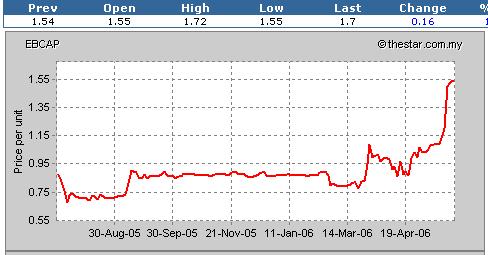
Take a look at the stock price and ze yellow card it got from Bursa.

So EB Capital states that it is proposing a 1 for 2 bonus issue and EB Capital states that:

  • To the best of our knowledge, the Board of Directors of eB Capital are not aware of any particular circumstances contributing to the unusual market activity save as disclosed herein;

So does it make logical sense that they are not aware of anything?

So I am wondering, what is there to attract buyers to buy its share?

Is EB Capital bonus issue so seductive?

But then, which sane person would one to buy a share in a company which has yet to make a profit after being listed? And I wonder if the BOD of eB Capital is aware that they have yet to make a profit since listing?

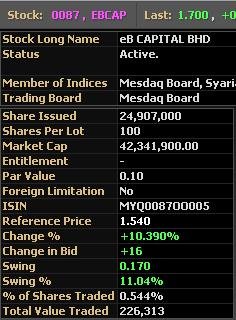
Oh, how much is the price of EB Capital now?

1.70 wor!!!!!

now check this out...


See the Market Capital of EB Capital based on a price of 1.70?

42.341 million!!

Sooooo....

You tell me lah.... how come sky NO eyes one?

So, so easy to be a million hair ar?
So, so easy to be kaya raya kah??

Am I being too cynical?

But take a look at what is happening for EB Capital. Just form a company. Knowing how to make money is not a criteria, most important is to get the company listed on the Mess-Daq. And once it is listed, heck ze stock market might make you a million hair!!!

Oh, what a wonderful world!!

Read more...

YTL Cement: II

Tuesday, May 16, 2006

In the earlier post, YTL Cement, I wrote it in a rush and I forgot to highlight the current financial health of the company.

The very last quarter, 2003 Q2, YTL-C balance sheet showed the following.

Cash 129.047 million
Total borrowings 48.875 million.

versus

The last reported earnings, 2005 Q2, YTL-C's balance showed the following.

Cash 292.811 million
Total borrowings 860.200 million.

How? See how much things have changed in 2 years? Totally different company yes?

And then I did not mention the dividends issue. Did the enlarged share base had any impact on the dividends? The answer is NO. YTL-C has continued rewarding its shareholders yearly with a 20% gross dividend. Yup, the management had wisely kept its shareholders happy with the generous dividend payment each year.

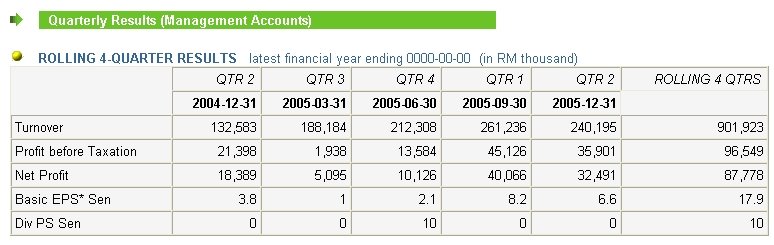
Btw.. look at the table above. Last year, things were not rosy at all for YTL-C. There was a cement price war and then there was the lack of construction jobs. Everything went haywire. And If look at their 2004 Q3 earnings in the table above, YTL only managed a net earnings of 5.095 million. And due to the enlarged share base, this works out to a mere 1 sen earnings per share! See how high the bar has been raised?

Anywayyyy... because of such factors in the economics of the cement industy, issues like price war and the dependance on the construction sector, which itself depends on the ruling govermental fiscal policy, for folks like UOB to project CAGR of 34.6%, I simply find it soooooooooo amusing.

Read more...

YTL Cement

Here's an example where a 'reputable' company, YTL Cement, issued new shares when it made an acquisition of another company. It's rather unique because in this example, there were several changes in the share base of the company and then there's the issue of dilutions caused by the conversion of warrants into ordinary shares.

Remember this mumbling of mine is only to highlight this issue and I am not here to lay judgement on the share or the company.. so do not simply ass-u-me hor!

Back in May 2004, I made the following table after YTL-C had made its 2004 Q3 quarterly earnings announcement.


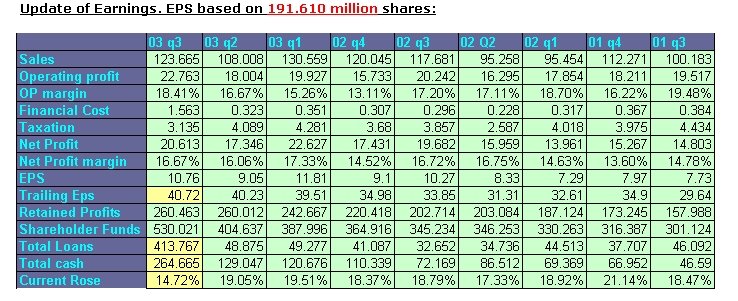
When YTL-C announced its 2004 Q3 quarterly earnings, YTL-C had just completed its purchase of Pahang Cement and in this acquisition of Pahang Cement, it stated that it will issue some 36.8 million new shares which works out to some 23.8% increment in the share base to 191.610 million shares and these shares were priced at 3.75 per share or at some 138 million.

Now here are some interesting notes.

Besides the dilution of earnings by some 23.8%, YTL-C also inherited Pahang's Cement's balance sheet in the acquisition.

Now check this out...

B4 the inclusion of Pahang Cement, YTL-C was in a net cash position of about 80 million...

After the inclusion, YTL-C turned into a company with a net debt of around 149 million.

And as can seen in the compiled table above, YTL-C debts balloned to over 413 million!

In terms of earnings per share. B4 the acquisition, YTL-C had a share base of 154.810 million shares.

The trailing earnings at that moment of time was 78.017 million.
Trailing eps based on 154.810 million shares was
50.4 sen.

But since the share base of 191.610 million shares, the trailing eps is now diluted only to 40.7 sen as seen in the compiled table.

How? Is the purchase of Pahang Cement worth the dilution in earnings?

Perhaps it was too early to lay judgement at that moment of time. Yes?

And then there was this complication made by this share
split announced earlier on March 2004. A 1 into 2 share split (this share split was also applicable for its warrants too! )

And to make it even worse complicating, the warrants were always in the money and was due to mature in Dec. ( One can cnfirm by looking at this
announcement )

And on the 8th Nov 2004, my live quotes showed the following info on the stock.

  • YTL-C = 386,777,248 million shares

    YTL-C Warrants = 92,829,508 million shares

So the new enlarged share base of YTL-C assuming FULL conversion of warrants = 479,606,756 million shares.

Now in Nov, YTL-C current/trailing net profit is now at 84.590 million. (yup, earnings improved )

EPS b4 full conversion of warrants = 84.590/386.777 = 21.9 sen.

EPS AFTER full conversion of warrants = 84.590/479.606 = 17.6 sen.

Now consider this issue... if one was holding 1000 shares in YTL-C in May 2004, the share split meant the investor would be holding 2000 shares of YTL-C after the share split. Which meant that the EPS AFTER full conversion of warrants is 17.6 sen x 2 or 35.2 sen per share. ( earnings per share was at 50.4 sen earlier before the purchase of Pahang Cement)

So is it wrong for one to consider the fact that their 'earnings shrank' despite the current/trailing earnings had increased from 78.017 million to 84.590 million?

Let's not pass judgement yet.

Last Sept 2005, YTL-C had a ICUL rights issue exercis. Pretty complicated (I had the whole exercise done b4 but to put it into this blog posting would make the posting extremely complicated) in which every YTL-C held was entitled to one ICUL and these ICUL can be converted to either 367, 490 or 549 ordinary shares depending on the time period when exercised.

Anyway, assuming full-conversion of these ICULS, YTL-C share base will potentially grow to 670 million shares or another dilution of 36%.

And it complicates matters more due to the fact that each individual investor would not think the same and probably most investors might not even hold this share for 10 years!

So perhaps it could be justifiable for some to consider that this whole ICUL exercise is a non-issue. But then some simply believe in buy and hold forever. How? Complex eh?

Anyway.. the reason I blogged this posting was because the Edge featured YTL Cement in their silly annual Top 100 exercise! ( did I say silly? Yup, I sure did. I could explain in details why I deem it as such but then it defeats the purpose of this posting. )

In the posting there were these interesting comments.

  • “We expect YTL Cement’s three-year earnings CAGR [compound annual growth rate] at 34.6%, on the back of recovery in cement prices, rising demand and cost savings from rationalisation of operations after… [acquiring] Perak-Hanjoong in FY2005,” states UOB-Kay Hian. The research house pegs YTL’s net profit for FY2006 at RM100 million. Results for the first six months of FY2006 show the company is well on track — net profits came in at RM72.6 million. Cement prices are also on the mend. After being bashed down in a five-month price war — RM100 per tonne (below the average cost of production) last May — prices rebounded to RM180 per tonne the following month. A foreign research house believes that local cement prices will jump to RM192 per tonne this year. UOB, meanwhile, expects prices to only hit RM192 next year and RM198 in 2008.

CAGR of 34.6%???

Wahhhhhhhhhhhhh... so highly optimistic, isn't it?

Now what is so interesting is that if YTL-Cement hits a net profit of 100 million or more this fiscal year, it would mean that this is the best ever earnings in YTL-Cement history! ( yeah.. cement buggers are showing some good fortune lately.. )

Now say assume a net earnings of 100 million as projected by UOB-Kay Hian. Based on current share base of 489.731 million shares, this would equate to an EPS of only 20.41 sen! Which means at current price of 2.39, YTL-Cement is trading at earnings multiple of 11.7x.

Would this deem as attractive enough to seduce any new investor(s)?

Would it seduce you? Record profits woh, you want to invest in it or not?

Ahh... this is where you can pass your own judgement. Has all these new acquisitions of new companies funded by issuance of new shares help improve YTL-C as a company?

Ahh... if your answer is YES... then it is YES, eh? Such strategy has helped improved YTL-Cement prospects.

Ahh... but if your answer is NO.. then it is NO. Yes? And isn't it kind of ironic that a company might be recording its highest ever fiscal year earnings in its history and yet it fails to excite anyone. If it cannot seduce new investors, then how?

Yeah, how brown cow?

Is the cup half-full or half-empty?

LOL!!.. just being ze devil here!

Read more...

When a Stock goes Bad...

Friday, May 12, 2006

When I was going through some compilation of some old articles, I came across this article written last year: When Stock Tips Go Bad, Is the Broker to Blame?

Here is an incredible article about a guy who was initially making tons of money in the stock market via the advice of his broker FRIEND. But when things started going wrong and the the stock market turned, his broker friend gave him a couple of advice, which turned out to be dead wrong. According to his broker friend, he was told not to worry about the falling market. Markets go back up he was told.

But sadly the market was not too kind on him. And the market failed to go back up. Hence, he decided to file a case. Truly incredible!

Here is a snippet from the article:

  • WHO is responsible when an investor loses money in the market? In the old days, before the Internet bubble burst, the answer was pretty clear. Absent egregious fraud on the part of the broker, an investor had to accept that investing in the market involved risk.

    In the wake of the technology crash, it appeared as if those standards might change. The New York State attorney general's office found that analysts - those in financial firms responsible for researching the health of the companies whose stock their investors buy - routinely gave positive recommendations on companies that they disparaged in private.

    Often, the financial firms where the analysts worked were seeking the banking business of those same companies, and the public recommendations were seen as a way to curry favor. One Merrill analyst, for example, publicly recommended an Internet darling called InfoSpace even as he privately called the stock a "powder keg" or worse.

    In a settlement with the Securities and Exchange Commission in April 2003, Merrill Lynch and other big firms agreed to pay $1 billion in fines and put $433 million into a fund to compensate some of their clients.

    That's a tiny fraction of the trillions of dollars that investors lost in the tech crash. After the settlements, law firms rushed to file class-action suits against brokerage firms on investors' behalf. The courts, however, were less favorable to the claims than they had hoped. One federal judge, dismissing a class-action lawsuit against Merrill Lynch and other brokerage firms, denounced plaintiffs as "speculators" who were trying to "twist federal securities laws into a scheme of cost-free speculators' insurance."

    Far from generating a mass of class-action lawsuits, disputes between clients and their brokers - including Mr. Murdock's with Merrill Lynch - have largely been decided in securities arbitration, an independent dispute-resolution system set up by the industry to apportion responsibility in these disputes. Investors agree to submit to arbitration when they open an account.

    The reports of conflicts in investment bank research have turned out to be largely irrelevant in arbitration: few clients can show convincingly that they regularly read the brokerage firms' research reports, and fewer still that they actually relied on them to make their investment choices.

    Ultimately, however, it is the brokers' advice that arbitrations like Mr. Murdock's are really about. Mr. Murdock said that as the market was falling, his friends thought he was crazy to continue taking Mr. Harris's advice. But for Mr. Murdock, the point of having a financial adviser is that his advice should be better than his friends'.

    .... Advice is the essence of why clients like Mr. Murdock go to full-service brokers. But one thing that is not commonly argued in arbitration is the very question that sends people like Mr. Murdock into arbitration in the first place: whether the broker's stock-picking advice was, in fact, good or bad. Even in the post-bubble world, that can be a hard sell to arbitration panels.
And the writer states Merrill's case.
  • Merrill says that this was a case of an investor who was lucky that an arbitration panel compensated him for losses that were his own fault. The firm says Mr. Murdock missed several chances to diversify into safe municipal bonds. "Mr. Murdock identified himself as an 'aggressive investor' and lived up to it," said Mark Herr, a Merrill spokesman. That Mr. Murdock got any award at all, he added, was "a case of catching lightning in a bottle."

How? The bugger was an 'aggressive investor'. And he lost money. Yet he laid the blame on the bad advice given to him by his broker FRIEND. And best of all, the bugger ' was perplexed about why, having won, he didn't get a bigger award. Not surprisingly, Mr. Murdock says his friendship with Mr. Harris is over.

But how sure are we which side of the story is correct?

Are all brokers really bad? Or perhaps we are witnessing the case of some bad customer? Customers who should be blamed for their own folly for being too reckless in the share market!

For instance in this other article, Putting stock in brokers' pasts , the article tells the tale in which a 53-year-old widow was 'seething with anger toward a Dallas stockbroker whom she blames for losing more than $700,000 that her husband left her when he died'.

  • In 2001, Ms. Newfield accused Mr. Cowle of losing her money in unsuitable high-tech stocks and of making unauthorized, rapid-fire trades in her account to generate commissions and other fees that topped $600,000.

    “It has been a few years now, and not a day goes by that I don’t think about how this man ruined my life,” Ms. Newfield said earlier this year. “I don’t trust anyone anymore.”

That was the customer version of the story.

And this is what the broker had to say.

  • Mr. Cowle, who points to his successes with thousands of clients over 20-plus years as a broker, replied in kind. He said Ms. Newfield ordered all the trading and withdrew money from the account to buy furs and Tiffany lamps.

    “I was a constant reminder to her that she was spending money like a drunken sailor,” he said. “She laughed and said she would make it back in the market. I warned her.”

Well, according to article, 'What she didn’t know was that in the preceding three years Mr. Cowle had been the subject of his second and third investor complaints, which alleged that he bought stocks without permission, according to records from brokerage regulator NASD.'

Ahh ... the broker had a questionable past history. Perhaps she might have done her money justice if she did some homework before trusting her money with the broker.

Which reminds me of this story last year:
Angry shareholders at Fountain View AGM

  • Some shareholders told reporters the board refused to comment on the arrest of substantial shareholder Datuk Chin Chan Leong who is also Yam’s spouse; or provide an explanation for the company's share price performance and why Yam had sold off a bulk of her interest in the company just before its share price plunged.

    “It was very tense inside (the AGM). Directors told us to limit our questions to matters regarding specified resolutions or the company’s performance last year. They left us in the dark about the fate of our investments, said one shareholder who walked out in frustration halfway into the meeting that ended in just under an hour.

Back last year, I wrote the following notes in my old forum.

  • In such a situation, of course it was very clear that Fountain was simply playing some real nasty funky music from day one. And if one had taken into consideration the business fundamentals of Fountain (ps Fountain reported losses in their latest earnings) , then logically one should never had invested in it from day one. So crudely said, the shareholder needs to realise that this is the sharemarket and nobody forces you to make such a simply rotten and silly investment. And at the end of the day, it was the shareholders' own decision to buy this share and I think it is high time they pay the lesson for their folly and greed in making such a poor investment.

    And the most amazing thing is.... why are they STILL staying invested in a such a company? Shouldn't they have done the logical and sensible thing, admit their folly in their investment mistake and move on by dumping the share? By not admitting and continue to be invested in such a company only give such rotten owners a second or even a third chance to cheat them. Make sense?

    LOL!!!

    It's no wonder why they say, they will always exist folks who are dying to be suckered in the sharemarket!

Have I changed my view today?

Nope.

On one hand, I reckon those buggers involved in the rigging of the share price should be punished heavily. On the other hand, I do reckon that buyers of such shares should be responsible to themselves. They have no one to blame if they make any reckless investment in the sharemarket.

No one has any divine right to win money in the share market.

The share market owes no one anything!

Which brings me to dear old Iris.

Well, I do not want to say much about Iris except that I came across a good blog posting on it: An Open Letter To Securities Commission

  • Some proposed rules for designating a security:

    1) A stock should be designated if it has hit the 30% limit up twice out of three trading sessions. In KLSE, a stock can only move up 30% in one trading session. The rule would not apply to shares whose prices are below 30 sen. The rules would also not apply to the first 3 trading days of an IPO. If a share already moves up two times in limit up, the share price effectively could be:
    1.3 x 1.3 = 69% gain.
    Anything more than that within 2 trading days is certainly excessive.

    2) A stock should be designated if it has risen by more than 100% in 5 trading days. This should be obvious.

    3) A stock should be designated if it has risen by 200% in a month. Again, pretty obvious - a stock that has tripled within a month means too much inherent speculation is still apparent.

    4) Above and beyond those 3 rules above, the SC would then have the liberty to step in. This is to prevent syndicates who try to "navigate around the above rules".

    5) To be released from designation, it is after a fixed 2 week period.

    Rationale:
    a) These rules will be administered strictly, hence investors can be assured of the prevailing rules and goalposts (and not have these bloody goalposts shifted every now and then, sometimes not even knowing if the goalposts even exist, not knowing how much is excessive speculation each time in the opinion of the SC).
    b) If the stock really has gained enormously in fundamentals (projects, prospects or profitability), a designation WOULD NOT and SHOULD NOT stop genuine buying. The rules are meant to rein in excessive speculation.
    c) The proposed rules have already given ample room for stocks to move up. The lifting of designation is also fixed, so again no room for hanky panky.
    d) Removes monitoring by SC, it is an automatic designation, no room for questionable practices. The SC would only step in if certain companies try to navigate above and beyond the proposed rules.

    If we were to implement these rules, Iris Corp would have been designated a long time back. Investors would have known the price levels to avoid entering as they know Iris would have been designated if they bought close to certain price levels. The benefits of knowing when a stock will be designated is too high, .... even to get the SC to delay designation by one trading session would yield an enormous edge for those who knew. That suspicion has to be eliminated completely.

Read more...

  © Blogger templates Newspaper by Ourblogtemplates.com 2008

Back to TOP