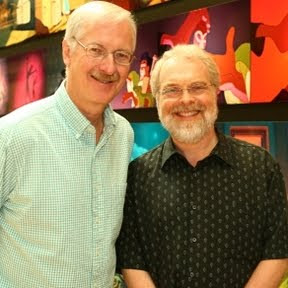
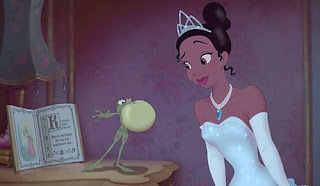
You have created some terrific and beloved characters, do either of you have a favourite?
Ron Clements; It's tough to pick favorites. It's like ranking your children. But I've always been particularly fond of Sebastian the crab from "The Little Mermaid." And I also have a soft spot for Ray the firefly in "The Princess and the Frog."
The sequence in the restaurant has a distinctly different animated style, what was your thinking behind that?
John Musker; Because it is her fantasy, it seemed like it gave us the opportunity to style it different from the rest of the film. Sue Nichols Maciorowski, a wonderful vis dev artist, brought the work of Aaron Douglas to our attention. He was African American and a member of the Harlem Renaissance and he produced amazing drawings and murals in a Deco style. We thought having an illustration in that style, which was her starting point for her restaurant come to life, would be graphically exciting. At the film's climax, when Facilier offers to make that dream real, we could then take those stylized images and make them more dimensional, which might make them seem that much more enticing to her.
What can you tell us about your next project?
John Musker; It is "in development" as they say. We are exploring a number of ideas, all of which we envision as hand drawn. The studio does have "Tangled" coming in November in the States, an adventure based on a fairytale with songs by Alan Menken, and directed by Byron Howard and Nathan Greno that is being done in CG. Glen Keane the exec producer is trying to get more of the looseness and expressiveness of his 2D animation into the CG animation. It is looking really promising.
The Princess & The Frog sees the creation of the first African American Disney princess, did you think it was about time?
Ron Clements; In retrospect, it was certainly about time. But we didn't approach this movie with that as any kind of agenda. John Lasseter suggested taking the fairy tale "The Frog Prince" and setting it in New Orleans. The idea of making our heroine African American simply grew out of the setting and that was an integral part of the story we pitched to John in March of 2006. We all thought it was a great idea. But it wasn't until later that we fully realized the importance of this in the African American community.
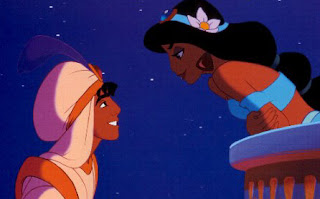
"It wasn't until later that we fully realized the importance of this in the African American community." What impacts have you seen?
Ron Clements; We have been thanked personally by a large number of African American Moms who have been thrilled to see a Princess that looks like them and their daughters up on the big screen. At times these have even been tearful and it's been very rewarding.
What was your most memorable experience working on The Princess and the Frog and what was the most difficult part for you in creating this film?
John Musker; Our trips to New Orleans were very memorable and meeting great people down there like Coleen Salley, a salty septuagenarian (white woman) a raconteur and full fledged "character" who influenced our writing of Mama Odie. We also met Leah Chase, a great lady who runs the Dooky Chase restaurant with her husband. She is in her eighties I believe, still works, started as a waitress, and is an amazing combination of warmth, gentility, and grit. She inspired some of our approach to Tiana. We also recorded Dr. John down there and got to ride on a float in Mardi Gras. The toughest hurdle was when Ron Clements, my partner, discovered he had to have open heart surgery because of blockages in his arteries. He recovered amazingly well but at the time we had no idea how debilitated he would be.
Do you find a difference in the way people identify with this style of animation, as opposed to the newer, digital process?
Do you think, with the advent of 3D technology hand-drawn animation will still have a place?
Ron Clements; I certainly hope hand drawn animation has a place. The Academy Award nominations for best animated feature were interesting this year in that they contained two stop motion films, ("Coraline" and "The Fantastic Mr. Fox"), one digital film, ("Up"), and two hand drawn films, ("The Secret of Kells" and our movie). It's nice to see this kind of diversity. Really, they're all just different kinds of paint brushes and I don't think it's necessary for the same paintbrush to be used all the time on every movie.
Breaking with the oft-criticized tradition of the damsel in distress being rescued by the shining hero, did you set out to turn Tiana into an empowerment figure for young females of today?
Ron Clements; We always liked the idea of Tiana being a different kind of Disney Princess. She's the first one to have a job and a career goal. We created the character of Charlotte to poke fun at some of the Princess stereotypes and to contrast with Tiana. We thought of Tiana as being a kind of modern Princess.
There are a number of 'in house' jokes in the film - streetcar A113, Firefly Five Plus Lou - do you each throw these in, or is one of you the chief pun artist? And which is your favourite joke?
John Musker; I attended Cal arts with John Lasseter and Brad Bird among my many talented classmates. We studied animation in room A11, so I always wanted to put a reference in one of my projects to acknowledge my kinship with them. The Firehouse Five reference came from both I think. Although, I can't remember if it was Eric Goldberg who thought of the “plus Lou" variation a la "plus Two." We both saw Frank Thomas play piano and wanted to do a shout out to him. I wanted to do caricatures of some of our coworkers as characters, so the prince's group of female admirers are actually based on Ali Norman, Jen Kilger, Shanda WIlliamson, Elissa Sussman, and Lorry Shea, all ladies who worked hard and well on this production.
How much impact do the people you cast as voice actors have on the characters and the story?
John Musker; They have great impact. We often hire actors who can improvise in character and certainly Jim Cummings and Anika and Bruno could all do that. Tiana got her dimples and her left handedness from Anika. Bruno has a big handsome toothy smile that got grafted onto Naveen and the space in Facilier's teeth came from Keith David.
It's been reported that there were some changes to the title and character names as a result of Tiana being the first African-American Disney Princess. How much truth is there to that? And did that lead to new pressures?
Ron Clements; The original title of the movie was "The Frog Princess" which was the title of a children’s book by E.D. Baker which Disney bought the rights to in 2003. After a bit, we decided to change the title to "The Princess and the Frog". This is not unusual. Many of our films have undergone title changes along the way. Also, Tiana was originally named Madelyn, (nicknamed Maddy), in our original treatment. But we changed it to Tiana, which means "Princess" in Greek. Once again, name changes happen a lot as stories develop. But we did feel this film was under an unusual microscope as it developed and that did create a certain kind of pressure. Our goal was always to try and be as sensitive as possible while always staying true to the story we wanted to tell.
There's the influence of Louis Armstrong in Jungle Book (which he was once intended to be part of), in Aristocats (Scat Cat), and then you created Louis, the alligator. How do you explain that success of the famous trumpet genius in animation?
John Musker; He is one of the greatest entertainers in American entertainment. He was so emotive. And he created an indelible impression with both his soulful trumpet playing and his jazz voicing and phrasing, with his singing, equally distinctive in that powerful sweet growl, and in his look as well, with the sweat, the handkerchief, the smile and the squint. He was an icon both aurally and visually.
I was told by Mark Henn that the design and personality of the different characters were set during a week end at a hotel resort. How and why did you choose that way of processing to create the characters? Do you think that's more stimulating or emulating that way? Or else?
John Musker; Sometimes when we are developing these films, sequestering ourselves in a different environment can provide a focus away from other distractions. There's no "right" way to do it but this one was very collaborative and helpful I believe. And then you stroll out of doors in this beautiful setting of Ojai and wish you were playing golf there.
Were there any complaints from the subjects about how their caricatures looked?
John Musker; Lorry Shea the feisty redhead occasionally complained that I made her look too short, but she is short and that's part of her dynamic appeal. At least that's my story and I'm sticking to it.
You mentioned the tradition of kids rewatching Disney flicks time and again. Do you ever reach a point where you can't watch one of your films again?
John Musker; I usually don't go out of my way to see our films after they are released. We see them so many times during production that we see them in our sleep. I still see the mistakes and things I would have liked to change or now see as improvable and it can make a neurotic person like me even a little more cuckoo if that's possible.
You said "We see them in our sleep". That must make for some pretty impressive dreams!
John Musker; And occasional cold sweats.
You two are responsible for making some of the most celebrated Disney films, what is the `secret’ to making a Disney 2D animated classic?
Ron Clements; There's no secret. It involves a lot of hard work and utilizing the abilities of many talented people over a long period of time. No matter how many animated films you've directed, the new one is filled with all kinds of new problems and challenges. The goal is to try and figure out how to make this particular movie before it has to be released in theaters.
How much did "Cinderella" impact on the making and storyline of "The Princess and the Frog".
John Musker; Certainly Cinderella was one of our influences both in the broadest sense in that this is a "Cinderella" story, an underdog tale, a story of a girl who gets to trade her working clothes for a beautiful ball gown, and in some of the more specific imagery when we had our Mardi Gras masquerade Ball a la Cinderella's ball. We thought of Mama Odie as our bayou fairy godmother. Our designers like Ian Gooding, and particularly Lorelay Bove, are big fans of Mary Blair the brilliant designer who had such an impact on the Disney animated films of the Fifties. I saw Cinderella a number of times when I was preparing to attend CalAts to study animation and I marveled at how entertaining it was and still is.
Anything else you'd like to mention about the home entertainment release?
John Musker; There are bonus features which include excised scenes, and we have some of the live action choreography we shot as a guide and literally a “jumping off" point or should I say "dancing off" point for the animators.
Which scene took the most drawings to animate and does it emerge as one of which you're most proud?
John Musker; The song "Friends on the other Side" was very very complex in terms of the effects animation, all that magic, and the tarot card animation, the voodoo doll chorus and the choreography of all. We are happy with the way it turned out and the fine work Facilier animator Bruce Smith did, our choreographer Betsy Baytos and dancer Dominique Kelly did, and the amazing effects work of Marlon West and the color of Ian Gooding.
After a lifetime of animation, are you able to walk into a room WITHOUT identifying which object would be the best to suddenly spring to life and start singing?
John Musker; We try not to be too overwhelmed by the props around us but I do carry a sketchbook around at times and even people sometimes unbeknownst to them find their way into these films. And oh yeah, that coffee maker over there.
Who is your best test audience?
John Musker; We show the film to the staff while working on it. Some people are known as "good laughers'. If we amuse them we feel we may have a chance. If they are stone faced we know we are in trouble. When we preview the film for the public we did have a preview on an earlier film where there were technical difficulties and a bit of a wait and children and parents already overloaded on soft drinks. That... I would not recommend.
Blu-Ray is sometimes described as TOO high res, actually detracting from the quality of some films. Are you happy with the Blu-Ray version? Which do you prefer?
John Musker; I like the Blu Ray version and the earlier ones they did of Pinocchio and Sleeping Beauty are stunning and I would recommend the Blu Ray versions to anyone looking for the premium version of the film. The Blu Ray also has a feature where you can watch the entire film in rough animation pencil drawings so for students and fans of animation it's a unique opportunity to see the film as it was before completion.
Ron Clements; In the case of modern animated films, all the final color work we do is in a very high definition digital format. This is the way the film is projected in digital theaters and is the ideal way we intend the film to be seen. Film resolution is actually not capable of producing all the subtleties of color that digital can. In that respect, Blu Ray is the closest thing possible to seeing the film as intended.
**The question I wish I asked.


 Forget singing lessons and pops stars, for Mandy Moore it was a little mermaid who first made her want to be singer.
 During their time in Australia the Golden Globe nominations were announced, with Tangled up for animated feature and original song. With Oscar nominations at the end of next month, the film is a sure thing to fight it out against Toy Story 3 and How To Train Your Dragon in the animation category.
 You would think the pair have established a playful banter from their hours in the studio working together on the film, but they say the only time they really got to collaborate together was afterwards.