Powered by Blogger.

Home

Reminiscences of a Stock Mumbler: II

Sunday, April 16, 2006

Flashback. April 20th 2005.

Dynaquest iniated research coverage on steel-based products maker, Yung Kong Galavnising Industries Bhd on the Bursa eresearch website (click here for the article). (ps. Dynaquest has been a staunch supporter of Yung Kong since 2003, featuring it on its Sunday Mail write-ups)

Here is a snippet from the report.

  • 3. Valuation:

    Attractive valuation & well-managed company. There are no local listed comparables for YUNKONG, as the other four major players in the galvanising sector are not listed. However, at the current (as at 15.04.05) price of RM1.29, YUNKONG is trading at a prospective P/E multiple of only 8.1 times and a DY of 2.33% nett. Its current price is also near its 3-year low of RM1.25. Based on both fundamental yardsticks, the current valuation of YUNKONG is considered cheap in view of its relative high EPS growth rate over the long-term (5-Yr: 5.31% & 10-Yr: 11.25%). In addition, YUNKONG is a relatively well-managed company and its long-term prospects remain favourable.

    FY2004 in Review

    Unable to fully passed on the higher costs to its customers. For FY04, YUNKONG recorded a 9.5% increase in earnings to RM10.11m on the back of almost 23% rise in sales to RM269.19m. The improved sales and earnings performance for FY04 was due to higher selling price of its steel products. However, due to higher cost of raw materials and other inputs which could not be fully passed on to its customers as well as an increase in administrative expenses (+28.4%), the EBITDA margin for FY04 fell to 11.04% from 12.52% in FY03. The FY04 EPS rose to 15.65 sen (1Q: 5.84 sen, 2Q: 4.28 sen, & 3Q: 3.30 sen & 4Q: 2.23 sen) from 14.55 sen (1Q: 5.22 sen, 2Q: 4.51 sen & 3Q: 3.22 sen & 4Q: 1.60 sen) in FY03.

    FY2005 Prospects

    Double-digit sales growth anticipated. YUNKONG is expected to record double-digit sales growth in the current FY (FY05) as a result of increased selling price of its products as well as increased production following the recent commissioning of its NOF-CGL at its Klang factory.

    However, with higher depreciation and continuous pressure on profit margin from the high CRC prices, the bottomline profit of YUNKONG is likely to show only a small improvement. In addition, start-up losses from the new galvanising line are also expected to affect its bottomline profit for the current FY.
    Hence, we are forecasting only a slightly higher EPS of 16.0 sen for FY05.

    Longer-term Prospects

    Growth will come from capacity expansion. In spite of the short-term pain, the longer-term outlook of YUNKONG remains bright as its expanded to become an integrated manufacturer of galvanising products. The profit margin of YUNKONG is expected to improve once the prices of its raw materials, particularly CRC, stabilise. It’s the volatile movement of the raw material prices and NOT the high prices that put the pressure on YUNKONG’s profit margin.

    During an upswing, there will always be a time lag before YUNKONG can fully passes on the higher cost. On the other hand, during a downswing, the selling price of YUNKONG’s products will be immediately adjusted downward due to competition but it will be a while before its stock of raw materials at relatively higher prices is cleared.

    7. Balance Sheet:

    Rising net gearing. The aggressive capacity expansion by YUNKONG over the last few years had weakened its balance sheet. The net borrowings of YUNKONG have risen from RM44.89m at the end of FY01 to RM194.08m at the end of FY04. As a result, its net gearing soared from 0.6x at the end of FY01 to 1.9x at the end of FY04. Net gearing will be reduced after proposed Rights & Special Issues. YUNKONG’s current net gearing of 1.91x at the end of FY04 will be reduced to about 1.77x after the proposed Rights and Restricted Issues.

    8. Recommendation:

    We are initiating our coverage of the Company with a "LONG-TERM BUY" recommendation at the current market price of RM1.29.

Look at some of the reasonings made by Dynaquest to justify their buy recommendation...

  1. Low PE multiple 8.1x.
  2. DIY of 2.33% nett
  3. Current price of 1.29 at 3-year low
  4. Growth stock: (5-Yr: 5.31% & 10-Yr: 11.25%).

* Some reasons not to buy?

1. Ze debt issue. See how Dynaquest analyst IGNORED the issue about the massive build-up in debts... debts went from 44.89million to rm194 million? Ah.. remember how some argued that borrowings is needed to finance growth? And that in order to stay on top of the game, further capital expansion and continued spending on research is needed.

On the other hand, the arguement is simply on how prudent the management is. No one has said that capital expansion is bad or said that borrowing is bad... but... there should a limit on how much a company should spend. By being too aggressive capital expansion could be deemed reckless. One cannot use capital expansion as an excuse. There is a saying that one should only buy a hat that fits their head.

Ahh... such classical arguements... anyway... Dynaquest argued that the proposed rights issue by Yung Kong would help lessen this debt issue in the near future.

2. Low PE. I have always argued that the PE only reflects how the stock is trading in the market when gauged against its earnings. It states NOT about the quality of the stock. Simply put.. not all low PE stocks would equate to a great investment.

3. DIY of 2.33%... err.... not terribly exciting isn't it?

4. Trading at a 3 year low? Waahh... does that justifies an investment?

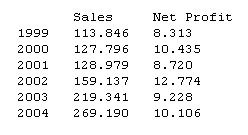
5. Growth stock? The following table highlights Yung Kong track record. Where is the growth? All I see is a very inconsistent company.
6. The inability to pass the cost down to its customers as mentioned by Dynaquest is a worry!

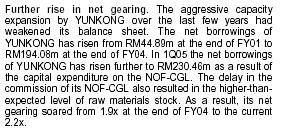
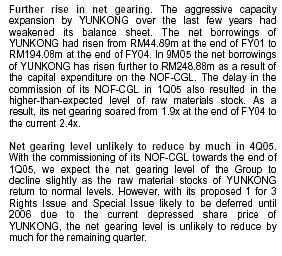
Article was written on April 15th. Few days later Yung Kong announced its quarterly earnings. Yung Kong a net earnings of 1.683 million or an eps of 2.6 sen. It's quarterly earnings improved by some 17% but its year-to-year net earnings dropped an alarming 55%. (see snapshot of Dynaquest's write-up on Yung Kong's earnings )

And the debt issue? Did it improve? Ahem... net borrowings has risen further to rm230.46 million!
And what did Dynaquest conclude in their write-up?

  • We are maintaining our "LONG-TERM BUY" recommendation for YUNKONG at the current market price of RM1.27.
Still a buy wor... Incredible!

Never mind, let's give it a benefit of a doubt for this quarter. Anyway, 3 months later, Yung Kong announced its next
quarterly earnings.

Yung Kong announced it made 1.665 million for the quarter or 3.348 million for its first 2 quarters of the year or an eps of 5.15 sen. (ahem.. dynaquest's projected eps was some 16 sen for this fiscal year!)

And here is Dynaquest write-up:

Ahh... Dynaquest is forced to lower the EPS forecast from 16 sen to only 12 sen.
  • In view of the weaker-than-expected 1H, we are revising downward our full-year EPS forecast to 12.0 sen from 16.0 sen previously. However, DPS for CY05 is projected to be maintained at 3.00 sen nett.
Discounting the debt issue... which now has grown to RM258.52m!... and the fact that Yung Kong's first half earnings has now plunged 49% compared to a year ago.. Dynaquest gave the following recommendation:

  • We are maintaining our "LONG-TERM BUY" recommendation for YUNKONG at the current market price of RM1.06.
Ahem.. previously... 1.29 buy, 1.27 buy and now 1.06.. it's still a buy for the long-term!

Shocking? When Dynaquest lowered their earnings forecast for Yung Kong from an eps of 16 sen to 12 sen, Dynaquest is effectively downgrading Yung Kong's earnings by some 25%. Now after such a hefty downgrade in earnings, how could Yung Kong still be worth a buy?

3 months later in Nov 2005, Yung Kong announced its 2005 q3 quarterly earnings.

How did Yung Kong do? Well it reported a loss of 1.214 million!

And here is Dynaquest following
write-up.

And again, Dynaquest defended the poor result and again it ignored the debt issue.

And what was Dynaquest recommendation?
  • The current price of YUNKONG had factored in the bearish outlook for the short term. Hence, we are maintaining our "LONG-TERM BUY" recommendation for YUNKONG at the current market price of 86 sen.

My oh my, still a long term buy at 86 sen? 86 sen??? WOW!!... and Yung Kong was just trading at some 1.29 some 9 months ago!

How?

Current poor price of 86 sen had been factored in the bearish outlook?

Huh?

And the following picture says it all...


Oh.. and a couple of days later... Yung Kong announced the following announcement.

That rights issue thingy that Dynaquest had mentioned so many times b4..

  • On behalf of the Board of YKGI, Malaysian International Merchant Bankers Berhad ("MIMB") is pleased to announce that the Securities Commission ("SC") had, via its letter dated 24 November 2005, approved an extension of time of six (6) months from 29 November 2005 up to 29 May 2006 for the implementation of the abovementioned Proposals, subject to the terms and conditions as earlier stipulated in SC's approval letter, dated 30 May 2005.

Hmmm.... seeking extension? Why? Would it be wrong for one to speculate that perhaps Yung Kong is seeking an extension because they could not find a buyer and that perhaps their shares is NOT LAKU?

And the latest development? Yung Kong announced their 2005 Q4 quarterly earnings on Feb 2006.

Yung Kong posted a loss of 1.513 million for the quarter and ended their 2005 fiscal year with a mere profit of 620k.

And this is what Dynaquest had to say in their research write-up and the following is their recommendation:

  • The current share price of YUNKONG had factored in the bearish outlook for the short to medium term. While the worse for YUNKONG may be over, earnings recovery to the pre-FY05 level may still be several quarters away. Hence, we are downgrading YUNKONG to a "HOLD" from a "LONGTERM BUY" at the current market price of 83.5 sen.

ahem!

Read more...
Reminiscences of a Stock Mumbler.

Friday, April 14, 2006

Date: June 28th 2003.

The Star Biz published a news article on this company called AE Multi.


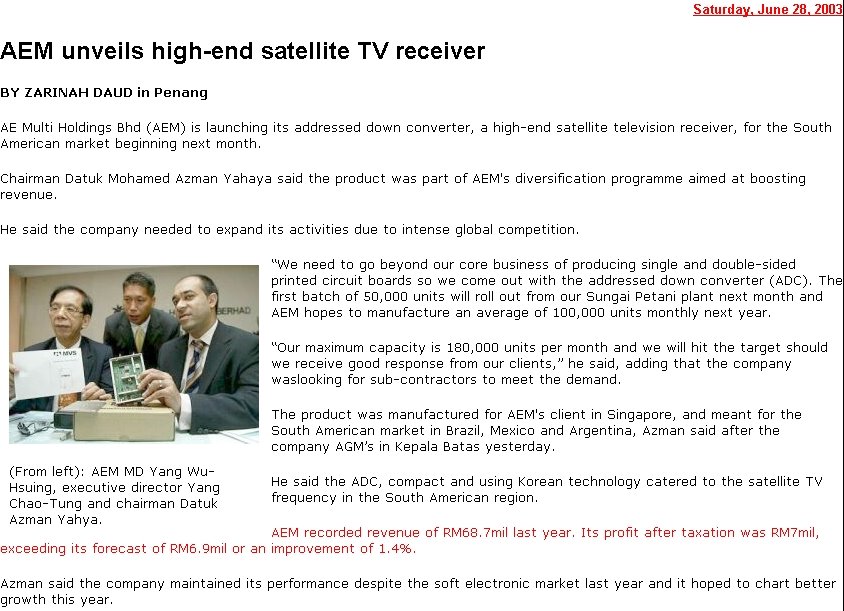
The above is the news clip. Do note what was stated in red (see below).

  • AEM recorded revenue of RM68.7mil last year. Its profit after taxation was RM7mil, exceeding its forecast of RM6.9mil or an improvement of 1.4%.
And below is AE Multi's quarterly earnings around that period of time.


The period concerned is highlighted in yellow.

Here are some very interesting stuff for me... :D

1. When a company has a news write-up on it and somehow the article only mention the previous quarter, one better be cautious. Why is the company focusing on OLD news? Doesn't it makes sense to find out why?

In AEM's case.

  • Sales 13.105 mil vs 18.319 mil (q-q)
    Net profit 0.383 mil vs 1.683 mil (q-q)

These facts were announced on 26th May 2003. Star article came out June 28th 2003. The Net profit dropped so much, but yet the company decided NOT to mention this in their press conference and instead only talked about the previous quarter earnings.

How? Don't you find it STRANGE that AE Multi decided to use the previous quarter earnings? Earnings which showed AE Multi made 1.63 million. Why didn't AEM use it's current earnings of a mere 0.383 million as reference?

Why?

2. Profit after Tax (PAT) does not necessary equate to net earnings. Taxes do need to be paid, right? And in the case of a newly listed companies, one has got to be very prudent since the earnings could include profits derived from the IPO listing exercise of the company.

In AEM case, pre-acquisition profit totalled 1.486 million. If you minus this out from the earnings announced, AEM actually did much worse than its previous year.

So perhaps one should ask if this was a slip-up by the company or was the company trying to dress up and glorify its earnings?

Here is the company statement again:

  • AEM recorded revenue of RM68.7mil last year. Its profit after taxation was RM7mil, exceeding its forecast of RM6.9mil or an improvement of 1.4%.

3. Whenever there is a drastic fall in the earnings, shouldn't an investor be worried?

Or shall one say that ze red flags should be raised, and one should be on the very alert to call it quits on a company whose business fundamentals are deteriorating drastically.

Look at the table again. By fy 03 q2 earnings release on 28th Aug 2003, one should have made up their minds to EXIT. This was a bad stock selection, time to move on.

What would have been the exit price?

Now it is very interesting to note that the day after it announced the second consecutive rotten results, AEM moved UP higher by 5 sen.

Logical? Investors/FundsManagers loving such rotten result, that they decided to push the stock up? Logical? and the stock continued moving higher to about 1.78, a couple of days later. Fishy and Smelly? or Smelly and Fishy?

The logical question one should ask is what if they knew that the company result is poor and that the future is bleak?

Doesn't it then make sense for them to push it up higher, so that they can sellout their holdings?

Well, all said, one should have exited this bugger in the 1.70 range...

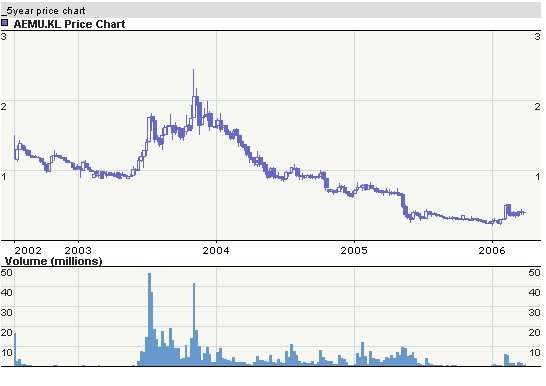
(of course it would probably looked REALLY BAD ADVICE cos AEM peaked at 2.44 a couple of months later!!.... LOL!!!!...... yup... yup.... see the chart below..... but do wait.... and see the end result today!)


4. That tracking of shareholding issue. See compilation made here:
AE Multi. Look at all those transactions.

I see nothing but disposal of shares.

Now again a simple reasoning should be made.

If them majority shareholders do not want their shares then why should you want to buy or even hold such a share?

Surely these majority shareholders know something much more of the company than you because just look at what they are doing.

Selling, selling and selling.... non stop SELLING!!

Isn't this the most decisive reason for one to sell and not even buy this stock?

Ah... for fy 2003 q3, the earnings turned around a lot. Net profit increased from 0.477 mil to 1.371 million. Fantastic improvement. This was announced by the company on 18th Nov 2003. Such a turnaround, did the majority shareholders/oweners vote with their money? Did they take the opportunity to buy more shares backed by such strong recovery in the company's earnings?

Sadly no... the company directors instead sold more shares in Dec 2003! Again what does this suggest to you? Doesn't it suggests that these buggers knew that perhaps the turnaround was not sustainable and that the company future ain't so good? Simple reasonings... no?

5. In our local market, the investing technique of Follow You, Follow Me is not a safe idea at all.

In AEM example, look who is one of star name owners.

If one invest in this stock just because of him, look at the end result.

AE Multi announced a NET LOSS of 13.024 million for its fiscal year 2004. (See how valid the arguement that when them insiders repeatedly SELL the stock as if there was no tomorrow, then it is quite likely that they know that something is wrong?)

AE Multi unaudited NET LOSS for fy 2005 was at 4.189 million.

So how much is AE Multi trading now? Well, yesterday it closed at 0.415. (now that 1.70 selling price... it's looking not too shabby eh?) (ps AE Multi traded lowest traded price was at 0.22!!)

ps.. AEM was offered at a price of 0.80 to the public and it was listed on 15th July 2002.

Now credit to Surf 88. This is what they posted one week after the AEM listing. They give it a big fat SELL rating on it!!!

  • AE Multi – Bucking trend?**
    By: Surf88
    Date: Tuesday, July 23, 2002
    Time: 8:28:02 AM

    Largest shareholder, Dato’ Azman Yahya, reduces stake from 20% to 18%
    Fundamental valuation expensive against regional peers and in view of industry dynamics and challenges
    Reiterate SELL as 13.4x Jun 2003 PER is unlikely to be sustained

    What sets it apart? AE Multi (RM1.17, stock code 7146) was a refreshing change from recent IPOs. Against our fair value of 91 sen per share and its IPO price of 80 sen per share, the stock opened at RM1.17 per share on its debut day of 15 July before hitting a high of RM1.50 per share. That marked the peak for the stock, which has been sliding since, as shown below :

    (RM) Closing price

    15 Jul 1.36

    16 Jul 1.33

    17 Jul 1.28

    18 Jul 1.26

    19 Jul 1.19

    22 Jul 1.17


    Is it time to buy? We think not and besides fundamental valuation, the latest development as reported last night also lends support to our view. At the time of listing, we mentioned that two factors may buoy share price to above fair value. First, its affordability at the RM1 region, and second, the sentiment boost stemming from the reputation of its non-executive chairman and largest shareholder, Dato’ Azman Yahya.

    Dato’ Azman Yahya reducing stake. Based on latest filings to the KLSE, Dato’ Azman Yahya has sold 1.6M shares or a 2% stake in AE Multi at RM1.25 on 17 Jul. This reduces his stake from 20% to 18%. While he is still the largest shareholder with a substantial stake, that he chooses to sell at the RM1.25 level may be seen as an indication of his expectations relative to stock fundamentals and the current environment. We believe minority shareholders should also take the cue from here, especially considering industry dynamics and valuation.

    PCB player with concentrated customer base. To recap, AE Multi is mainly involved in the production of PCBs (printed circuit boards). The company has a concentrated customer base with its top five customers accounting for nearly half of group sales. While track record has been reasonable, AE Multi does not seem to have a particularly strong competitive edge in the industry while there seems to be more challenges ahead. Firstly, PCB is increasingly commodity in nature which points to rising price pressures. Secondly, the emergence of low cost and technology-advanced competitors in China is another concern.

    AE Multi at 13.4x 2003 PER. Overall, we expect AE Multi to achieve its prospectus forecast of 18% pretax growth on improved contribution from its Thai plant (its only overseas plant at one quarter the size of the Malaysian plant) in 2002. Going forward, growth is expected to moderate in the absence of new expansion. EPS wise, due to enlarged capital following the listing, we forecast 11% growth in 2002, before a 5% decline in 2003. At the current price of RM1.17, AE Multi is trading at 12.9x 2002 PER, rising to 13.4x in 2003.

    Industry giant at 8.4x Jun 2003 PER. In our IPO note on AE Multi, we benchmark AE Multi to Singapore-listed PCB industry giant Elec & Eltek in view of the lack of meaningful domestic comparisons. Due to the global stockmarket decline, Elec & Eltek’s share price has fallen 7% since then and its PER as a result fell to 8.4x for the financial year ending Jun 2003. Considering that Elec & Eltek is almost 20x the size of AE, it seems difficult to justify and sustain AE Multi’s PER at 13.4x 2003 earnings. At RM1.17, the net dividend yield of 2.1% for AE Multi is also not particularly attractive.

    Reiterate SELL. In all, the latest developments serve to reinforce our SELL call on AE Multi. In this case, disposal by the major shareholder may well be a telling sign. SELL.

Read more...

How does one value a company one cannot trust?

Thursday, April 13, 2006

Here's ze trick question that I asked the other day again...

How does one value a company one cannot trust?

Remember this past blog posting on
MTD Capital's flip-flopping of its business?

  • ACPI to buy MTD Capital's construction arm for over RM80m

    What a shocker!

    What we have here is MTD Capital, a construction company, selling out its construction business to ACPI, a subsidiary company of MTD Capital for 80 million. And MTD Capital will then become a holding company!

    What the...!!!!!

    From an investor point of view, isn't MTD Capital simply moving away the 'cheese' from its minority investors???

    Isn't there a lack of respect from MTD Capital towards their minority shareholders?

    Put it this way.. if one had invested in MTD Capital because one believed in the potential of its construction business, this sale of the construction business has effectively taken out the very justification why one should have invested in the stock. How on earth is this possible? How can they allow such flip-flopping of business between subsidies?

I just realised that there is more!

Yup... more!

Malaysia's Metacorp Acquires 40 PCT Stake in Modal Ehsan

Two things strikes me from that news clip..

  1. Metacorp Berhad (KLSE:8389) has agreed to acquire a 40 per cent stake in property developer Modal Ehsan Sdn Bhd for RM10.4 million (US$2.8 million
  2. Modal Ehsan is a 60 per cent subsidiary of ACP Industries Berhad (ACPI) (KLSE:5924) which in turn is an associate company of Metacorp.

Ahem... when will all these ever end? Left hand selling to the right hand, right hand selling to the back hand, back hand selling to the under hand!!!

And to add extra icing to ze cake... there is this other news thingy: Malaysia's MTD Grants Granion Option to Buy MTD Infra Shares

Ahem!!!

Goodness me... what great corporate governance from this group!

So... how does one value a company one cannot trust?

When there is no corporare governance, how can the investing public expects to be given a fair chance to be adequetly compensated for taking all the risks in investing in their company?

How?

Remember the old adage...

Fool me once, shame on you.
Fool me twice, shame on me!!

to be continued... :p

Read more...

It's the calculations that counts.. !!

Tuesday, April 11, 2006

Hmmm ... remember this blog posting: It's the business.. Part IV

Let me show something really interesting...

  • Remember I mentioned that if an investor made an investment into Yi-Lai at a cost of 1050 back in 2003, the investor would have received 450.00 in dividends and I went on to calculate in the following manner.

    So from an investment outlay of 1050, the investor would have gotten a 450.00 in dividends or 43% back of their investment outlay. Which means that the investor current holding cost of Yi-Lai is 600.00.

    Currently Yi-Lai last traded at a share price of 1.30. Which means the investor is holding on to an investment gain of 117%!!!

    Which works to an annual compounded return of 29.4% for holding this investment for 3 years!!!

Did everyone realise that I am really cheating here?!

LOL!!!!!

Ah... let me show why. The invested capital is 1050. The return in dividends is 450.

Current market price = 1.30.

Current market price + dividends received = 1300 + 450 = 1750. Or a 'current' gain of 67%. (and not 117%!!!)

Which works out to a mere 18.56% compounded annual return for holding the stock for 3 years.. and not 29.4%.

See how I managed to glorified everything when I deducted the dividend received from my investment cost?

Ahh.... do you notice that Insider Asia write-ups... and do you notice how they deduct the dividends received from their investment cost?

The below is the snapshot of their portfolio published...

See how they have their 5,000 shares of Yi-Lai 'purchased' in 2003 has an average cost of a mere 61.5 sen?

And by doing so.... lol.... it just makes everything look so much nicer.... :p

Ahem.... it'sthe calculations that counts.. !!!

Read more...

Elsoft Research

  • And i would like to share with you my finding on elsoft. I know u dont like MESSdaq but it looks appealing to me. The best thing is no research house ever notice it yet. PLs comment.

There's not a whole lot of info I have on Elsoft and yes i dun see any research report on it. The best I can gather is via their website

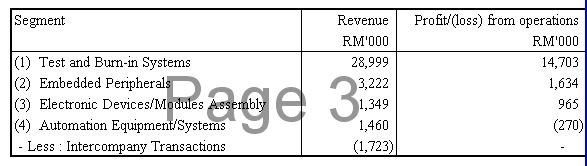
  • Elsoft is principally involved in research, design and development of test and burn-in systems and application specific embedded systems. Elsoft mainly provides cost effective ATE solutions to the semiconductor, optoelectronic and automation industries. The Group’s key product i.e. test and burn-in systems are used by its customers who manufacture optoelectronic devices such as LED, image sensors and automotive lightings to test their products before launching into the market. The name “Elsoft” consists of two elements i.e. Electronics and Software, symbolising the Group’s core competency in advanced electronics design and software technology innovation.

And here is some company historical background and here is what they do.

  • Elsoft offers the industry’s most comprehensive portfolio of design, validation and production test solutions from a single ATE supplier. Utilizing our unique Source and Measurement Unit (SMU) solutions, we enable customers to customize test flows that significantly reduce their design-to-volume-production test time and costs, while improving overall performance, quality and functionality. As a test and burn-in solution provider, in-house developers of the Group can improve an existing test system or design new test solutions to meet a specified test strategy required by its customers. The switching trend of the industry’s evolution from high cost test and burn-in solutions towards cost effective test and burn-in solutions has bridged the Group to the stage of the global ATE arena. Elsoft offers its customers a new paradigm of alternative test solutions which aims to provide high performance and cost effective application solutions.

Elsoft was listed on 27th July 2005 and it would appear that Elsoft is generous with their dividends. In the short time they are listed, Elsoft had already rewarded their shareholders with two set of dividends. (Interim Dividend and Second interim dividend) (Dude.. it's not too bad, huh?)

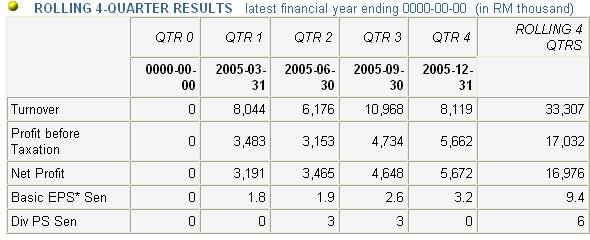
Here is a snapshot from osk/klsetracker.com on Elsoft quarterly earnings.

And again I have to say it is pretty impressive. It appears it has growth and the margins are really solid.


And this is what Elsoft has to say in their research report posted on Bursa website.

  • Turnover and profit before taxation

    Elsoft Research was listed on the Mesdaq Market of Bursa Securities on 2 August 2005. Hence, no comparative number was available for the preceding year corresponding quarter.

    For the fourth quarter ended 31 December 2005, the Group achieved a turnover of RM8.119 million. Compared to the RM10.968 million achieved in the third quarter ended 30 September 2005, turnover was 26% lower. In spite of lower revenue recorded mainly due to lower contribution from the Group’s subsidiaries, the Group’s fourth quarter profit before taxation rose 20% to RM5.662 million from RM4.734 million achieved in the preceding quarter.
    The growth in profit before taxation was mainly attributable to higher distribution from short-term investments, the writing back of overprovision for bonus and higher contribution from significant increase in repeat orders of test-systems that boosted profit margin.

    For the twelve months ended 31 December 2005, the Group recorded turnover and profit before taxation of RM33.307 million and RM17.032 million, respectively. The group’s effective tax rate of 1% for the period under review was lower than the statutory rate due to Elsoft’s pioneer status.

    Prospects

    Management is optimistic about the Group’s performance for the financial year ending 31 December 2006. The Group foresees LED test instrument growth to be driven by ramp-up in the use of High-Brightness LEDs in mobile appliances, automotive lighting, signals, signs and displays, illumination and electronic equipment.

    The newly developed test system catering for the Display/Intelligent Display market should contribute positively to the Group's financial performance.

    In addition, management is expected to streamline the Group’s operations to minimise duplication of tasks to save costs. The Group is putting more effort in the development of electronics instrument for the test and measurement market.

(Did you see the reason for the growth? - The growth in profit before taxation was mainly attributable to higher distribution from short-term investments, the writing back of overprovision for bonus and higher contribution from significant increase in repeat orders of test-systems that boosted profit margin. )

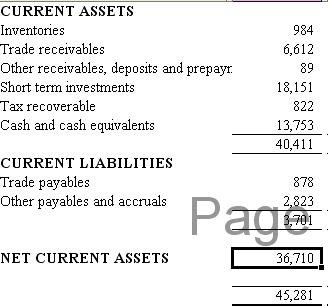
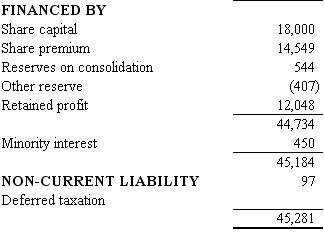
Here is a snapshot of its balance sheet.


Clean net cash... no debts... except the worry is the size of its short term investments..

If we look under notes b7.. this is what it states...


It's cash flows is ok..but we really cannot conclude anything much from it... too early days yet.

I have to admit that Elsofts operating profits are pretty darn impressive...


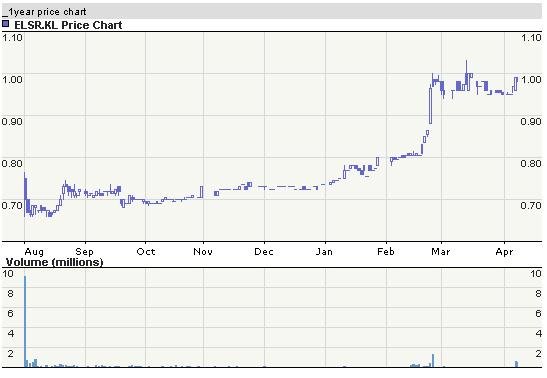
And here is how Elsoft did since listing...

how dude?

I guess i can understand why you have said that it looks appealing for you.. ur only worries are.. lack of demand of the stock (ahh... me sure u know how deep this issue is.. :p), the size of its short term investments and it's still too new to past any real judgement on it...

cheers dude!

Read more...

It's the business.. Part IV

Monday, April 10, 2006

In the previous post, Its the business.. Part III the example discussed was based on a stock which contniued to pay great dividends despite its slumping business. And if one had purchased the stock in 2002 for the sake of the dividends despite the fact the business was slumping, the end result was pretty poor.

Now let's look at another stock which pays good dividends. Click on the
Map of Mumblings and look at the series of blog postings on Yi-Lai , Yi-Lai: ROI Part II , Yi-Lai: ROI Part III , Yi-Lai: ROI Part IV and
Yi-Lai: ROI Part V

Firstly how is Yi-lai's business?

From the first post
Yi-Lai ,

Earnings since fy 2001: 21.7 mil -> 26.8 mil -> 25.6 mil -> 29 mil -> 27.8 mil

Ahh... Yi-lai's business wasn't too happening for its latest fiscal year. Latest fiscal year showed that earnings dropped from 29 mil to 27.8 mil.

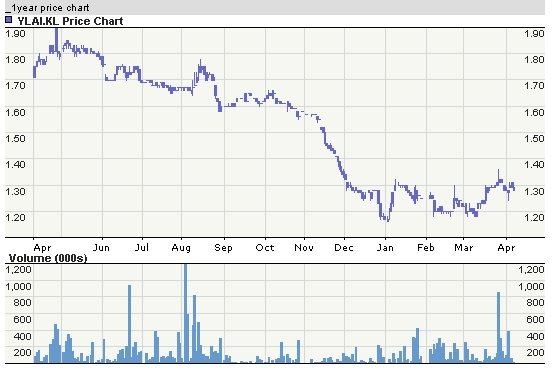
Not too happening right? And doesn't it reflect in the charts?


If one had purchased this stock last year at around 1.80, one would have been left holding some paper losses..

however...

there would be some who would argue that the correction in the stock price is not justifiable given the fact that Yi-Lai's business earnings performance wasn't really all that bad... since one is talking about a 4% slump in yearly earnings...

anyway... let's look at the end-result if one had purchased Yilai way back in 2003 at a price of around 1.05.


Not too shabby isn't it?

Let's ass-u-me that one had invested in 1000 shares of Yi-Lai at a cost of 1.05. Cost of investment 1050.

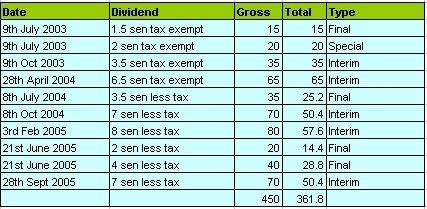
Now let's look at the dividends received by the investor. Here's a snapshot of the dividends paid by Yi-Lai since 2003.


The investor would have received a total gross dividend of 450 or an after tax dividend of 361.80. (but since one can claim these taxes back, I would use 450.00 as reference for the total dividends paid)

So from an investment outlay of 1050, the investor would have gotten a 450.00 in dividends or 43% back of their investment outlay. Which means that the investor current holding cost of Yi-Lai is 600.00.

Currently Yi-Lai last traded at a share price of 1.30. Which means the investor is holding on to an investment gain of 117%!!!

Which works to an annual compounded return of 29.4% for holding this investment for 3 years!!!

Fantastic?

Yup... now compare it with Multicode.

Why the huge disparity?

Ah.. all I can say is compare Multicode's fy 2001 results with current. Back in fy 2001, Multicode earned some 10.122 million and was operating with a net profit margin of 15.43%. Now? Multicode latest net earnings is only some 4.137 million. See the huge slump in business earnings?

Do you believe that ultimately it's the business that counts?

Read more...

Déjà vu..?

Sunday, April 9, 2006

Here is an interesting snippet from AIM's (Apollo Investment Management) 1st Quarter 2006 report.

  • The most irritating of the three duds was until recently a small-company gem, with ROE and EPS growth both over 20%, supplying services to the offshore oil and gas sector... déjà vu? remember the Pirates?... and once again we were mugged by Malaysians. This was an unpleasant surprise, since the company, Total Automation, was Singapore-based, excellently run by its founder-managers, and they were reporting no interference from their Malaysian shareholders - until the latter decided to sell the whole business to Wartsila of Finland. They did so on a PE of 11 for the year just ended, and on our estimates 8-9 for the current year, a strangely low valuation. The disposal announcement made no mention of distributing the cash proceeds: it said the board would ponder other businesses in which to invest. All executive directors resigned immediately, with no apparent thought of fiduciary duty to minorities. As startled investors who had bought the shares for its niche engineering business studied the diverse interests and dismal track record of listed companies in the controlling Melewar group, Total Automation shares slid to a discount of 25-30% to the expected cash. Seven weeks after the initial disposal announcement, having cancelled the routine analysts' briefing after the results and been parsimonious with access meanwhile, the company did announce an intention to distribute 75% of the proceeds, which may be sufficient to reduce protest - most investors will just curse and move on - but remains unfair, since the share price remains well below the level at which we believe it would have been trading if continuing with its existing business (7 times EPS for '06?), and the implied value attributed to the 25% balance implies no confidence in the directors. The pattern of trading and disclosure has been no credit to Singapore (nor of course to the Melewar group), and we were surprised to be told that minority shareholders would have no effective say. For the controlling shareholders to vote on the sale is fair enough, since unconnected, but we would have thought the decision should require a 75% majority, and/or that there should be a requirement for an immediate unconnected-shareholder vote on distribution of proceeds.
Well, I have blogged on Melewar before. (see Melewar and Melewar: Part II ).

Remember the blog posting
Philip Fisher: Management Integrity.

Let me repeat here again.

  • On the issue of integrity, this is a simple no-brainer. Does it make sense to go into a business-partnership with someone you do not trust? It is hard to imagine why anyone would want to go into a business partnership with someone who would most likely cheat us the minute we turn our back.

    According to Fisher, the management of a company is always for closer to its assets than its shareholders. And without even breaking any laws, there are number of ways that the management can benefit themselves and their families at the expense of the minority shareholders, for example employing their relatives, buy-and-selling of properties between relatives at above market rates or the issuing common stock options.

    It's not only the dislike for dealing with unscrupulous people but Fisher believes that companies managed by people of dubious integrity will definitely meet with failure. (Don't you agree?) For those in control would attempt to make money at the expense of the minority shareholders for these minority means nothing to them but mere other people's money who are there for them to abuse!

ps...

How does one value a company one cannot trust?

Read more...

  © Blogger templates Newspaper by Ourblogtemplates.com 2008

Back to TOP