Powered by Blogger.

Home

Spin masters keep spinning:

Wednesday, August 16, 2006

The following was taken from Mike Hartman's FSO Wrap Up.

I guess I always seem to get a bit suspicious and skeptical whenever the mainstreamers parade Abbey Joseph Cohen of Goldman Sachs out on CNBC to tell everyone where stock prices should be. Bottom line…she says stock prices should be 15% higher than they are today. If she is correct, the SPX should move from 1,290 to 1,483. It may sound far-fetched, but that’s her story and she’s sticking to it! Realizing the consumer is all but tapped-out, Ms. Cohen believes the driver to move stocks higher will be increased capital spending from corporate America and increased export sales due to a lower dollar and increased economic activity from overseas. Thanks Abbey, but I think I’ll stick with the resource sectors (things people need) because understated inflation is baked in the cake!

Here is where I believe she came up with the notion that stock prices are undervalued by 15%. If you look at stock prices relative to inflation, stocks are clearly underperforming. The S&P 500 Index moved through the 1,300 mark back in March of 1999. We are now more than seven years down the road and the index is once again approaching 1,300. Just to break-even against inflation, the index would need to stand at 1,483 to represent the same value it did back in 1999. The number is actually higher, but I base it on inflation adjusted numbers through 2005 provided by the Inflation Calculator at http://www.westegg.com/inflation/. I plugged in the data and the calculator reported as follows:

What cost $1300 in 1999 would cost $1482.68 in 2005.

Also, if you were to buy exactly the same products in 2005 and 1999,
they would cost you $1300 and $1139.83 respectively.

The S&P 500 needs to run 15% higher from where it is just to keep pace with inflation. Earlier I made the point that wages are actually negative relative to inflation, and now you can see that stock prices are also negative when adjusted for inflation. Most commodity prices are 200% to 400% higher than they were just a few short years ago, but wages and stocks are flat to negative. Higher mortgage rates, higher energy costs, record high debt burdens, and slowing home price appreciation are taxing the consumer’s discretionary spending. I can clearly see where the Perma-Bulls would like to take this stock market, but to see it happen we will need to see corporate America increase capital spending in the face of a slowing economy. We will also need to export some real goods to the rest of the world rather than simply continuing to increase our export of debt paper.

The Bulls could get their way with some improvements to the economic data, while at the same time maintaining the notion that inflation is not a problem. Frankly, I’m actually expecting just that between now and election time. “The economy is slowing but stable, and inflation is under control,” will be the mantra as we move into the Fall Season. Hey, crude oil even came down again in price today…no inflation with crude back down to the bargain price of $71.80! Politics and Wall Street spin are still ruling the roost in the financial markets as we move through these most uncertain and turbulent times.

The gains on Wall Street stuck like glue as Main Street begins to feel the crunch of a slowing economy! Just a couple weeks ago the Bears were telling everyone to be prepared with their crash helmets. Now we get some solid weakness in economic reports and the markets rally higher! The crash helmets have covered and today we see the Dow Industrials pounding higher by 96 points to 11,327, the NASDAQ Composite closed 34 points higher at 2,149 and the S&P 500 closed above key resistance with a gain of nine points to 1,295. The next few days should tell us if this is the beginning of the ramp-job into the elections, or if it’s just a nasty head-fake higher to flush-out the shorts! The Bears have a great case to present, but for now I wouldn’t underestimate the salesmanship of Wall Street Spin-masters to move stock prices higher.

==>>

See the case Mike is making?

Solid weakness in economic reports.

What does this mean?

Doesn't it mean that there is a strong solid chance that market earnings won't be good in the near future?

So why should the market run because of the solid possibility of weaker earnings?

Oh, the great Abbey Joseph Cohen came out guns blazing on CNBC saying that stock prices should be 15% higher.

And the spin masters keep on spinning.

Read more...

Top Of Ze World: VIII

From AP News:

KUALA LUMPUR (AP)--The world's largest rubber glove manufacturer faces fines of up to MYR121.2 million ($33 million) for employing more than 2,000 illegal foreign workers, a company official and news reports said Wednesday.

However, Malaysia's Top Glove Corp. said it expects to be spared from paying the maximum penalty.

Immigration officers raided a factory in Klang town, west of Kuala Lumpur, based on a tip-off and found that work permits for 2,071 of its foreign workers had expired, Immigration Enforcement Director Ishak Mohamad was quoted as saying by the New Straits Times newspaper.

Another 353 workers had no permits at all and 72 were without passports, he said. However, they were not arrested so the factory's production would not be disrupted, the newspaper said.

"The managers gave the excuse that they forgot (to renew the permits) or there were too many of them, but we don't buy that," Ishak was quoted as saying.

The Star newspaper quoted Ishak as saying it was "the first time the department has come across a case involving such a huge number of illegal workers in a single premises."

Under immigration laws, an employer can be fined up to MYR50,000 for each illegal worker.

Ishak and other immigration officers could not immediately be reached for comment.

Top Glove is the world's largest producer of rubber gloves for medical, household and industrial use.

Media reports did not identify the company, but Top Glove officials acknowledged it was their factory.

"It is an oversight on our part but we are giving our full cooperation to resolve this and to ensure it will not recur in the future," company executive director K.M. Lee told The Associated Press.

He said the fine was expected to have only a "minimal effect" on company earnings, noting that courts usually only impose maximum fines on employers who hire illegal migrants who enter the country without documents.

Lee said the company had been careless because of its rapid expansion in recent years but steps have been taken to strengthen internal monitoring. Most of the foreign workers caught were Indians, with some from Vietnam and Indonesia, he said.

Top Glove has 8,000 workers in eight factories in Malaysia, of whom 3,600 are foreigners, Lee added. The company also has two factories in Thailand and two in China.

Top Glove shares were down 3.3% at midday Wednesday at MYR8.70.

Top Glove closed at 8.65.


Questions/Issues.


1. Besides the issue of fines, assuming that the fines impact would be minimal, it now appears that Top Glove had been keeping its production cost low by engaging in such unlawful practise such as hiring illegals. So what's next?

Top Glove can't have this luxury no more. Right?

Which means its production cost will increase since they have to hire 'legals'.

Which means its bottom-line will be HIT in the future in regardless of the size of the fine.

2. Integrity issue!

This will stick out like a sore thumb!

How?

If proven guilty, it means that Top Glove is willing to engage in such unlawful activities to boost its bottom-line.

So how much can an investor trust this company?

3. How do you rate the management handling of this crisis?

The initial excuse of forgetting to renew the permits was as lame as it could get.


How?

past blog postings:


Top Glove..
Top Glove: Part II
Top Glove: Part III
Top Glove: Part IV
Top Glove: Part V
Top Glove: Part VI
Top Glove: Part VII

Read more...

eB Capital: III

Tuesday, August 15, 2006

On the previous blog posting on eB Capital I wrote the following. Before I start, eB Capital announced its earnings yesterday.

EB CAPITAL BERHAD (MESDAQ Market)

Quarterly rpt on consolidated results for the financial period ended 30/6/2006

New comments will be in red font.

----------------------------------------------------------------------------------------------------------------

Boyplunger raised the following issue on eB Capital.

  • I noted Redtone Technology Sdn Bhd has been accummulating EB Cap. Currently owning about 1.9m or 7% -8%.

    Why is Redtone buying the shares of this company? That is interesting. Did i miss out something on the company's history.

Yes, I do understand that Redtone International has been buying shares into this company.

Why is RedTone buying shares into a company that has real problem in making a profit?

I have no idea.

And yes, I do understand your thinking rational. Because the justification is if RedTone International is willing to buy shares into the company, surely there must be something in the company that RedTone sees as value. And surely no sane company would want to buy a company if there is no profit to be made. Right?

Hence, the argument is of course, perhaps one should follow and mimmick what RedTone does!

But if that is the case, isn't one implying that when one company or one individual purchases a share of another company, the buyer(s) reasoning to buy the share is always correct?

Here is something interesing regarding is the buyer(s) always correct issue. This blog eB Capital II was written on May 18th 2006.

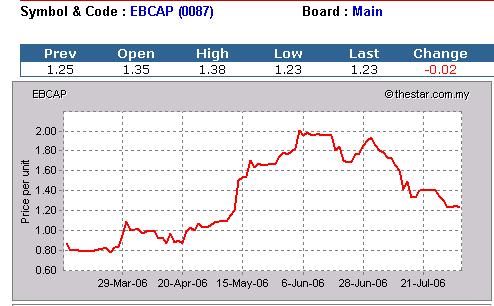
Look at the stock price chart of eB Capital during this period.

Stock last traded 1.23.

On May 18th 2006, the stock was trading as high as 1.70. Peaked at 2.00 on 5th June 2006.

But do we or would we ever know the true motives or intentions in such share purchases? Would we ever have the privilege to evaluate their reasonings in their share purchase?
If no, then aren't we making one huge assumption, which is the buyer(s) of the share(s) is always deemed correct?

Can such strategy go wrong? Did one sell this stock when it hit 2.00?

Let me give some examples on what could go wrong.

Take the series of past postings on Karensoft. Well, the boss has always been constantly buying back shares in the company. So is the boss deemed correct in his actions? Well as everyone is well aware, Karensoft has just been re-classified as the first GN3 stock in the Messdaq listing. Which is rather dead serious since this classification states that Karensoft financial health is in a utter dire straits. So was there 'value' in the share purchase? Or perhaps the boss was buying for personal reasoning, which sadly is the 'value of being a listed stock'. So if one had followed Karensoft boss actions in the market, how then? See the danger?

Or how about the infamous purchase of a controlling stake in the huge congolomerate, DRB-Hiccom? How much was the share purchase back then? Wasn't it around 3.50 or so? Ahh.. I am sure that you are aware that some argued that because since the controlling stake was sold at such a high price valuation, then surely there must be value in the stock since the stock was selling around 2.00 back then. And what's the price of DRB-Hiccom today? Would a follow you, follow me strategy work in this case?

On the other hand, there were success stories in stocks like Transmile.

Ah, I am sure you understand what I am trying to say.

There's simply no gurantees in such strategy.

Sometimes it works but sometimes it can be dead wrong.

So how?

What's the best gauge?

Look at eB Capital.

eB Capital supposedly specialises in wireless broadband technology.

There'e 2 things one can gauge it on since it's listing. Look at these past compilations I had made on EB Capital .

The first news clip.

  • With a current local market share of 0.54% in terms of broadband subscription, more efforts would be devoted to marketing its products and services to enlarge its share, he added.
    Meanwhile, eB Capital's historical earnings demonstrate its strong growth.
    The company registered a pre-tax profit of over RM1mil last year and an after-tax profit of RM560,000.
    Revenue increased to RM8.3mil in 2004 from RM2.5mil in the preceding year

And the next article...

  • Wireless Internet broadband provider eB Capital Bhd (eBCap) expects its subscriber base to grow in multiples of 10,000 over the next two to three years as it embarks on an aggressive recruitment drive after its listing on Mesdaq.

See how b4 listing, eB Capital boasted about its great potential and its track record.

After listing, eB Capital showed it true self.

How do you value such a company?

Secondly, take a look at eB Capital last reported earnings. Do you like what you see?

If you don't then... should you be bothered with what RedTone does?

And if I have to guess, perhaps RedTone wants to go into the wireless broadband industry.

By the way, based on current price of 1.70, do you reckon that eB Capital business is worth what the market is pricing it?

eB Capital reported a paltry sales revenue of only 2.730 million with a net loss of 236k, bringing half fiscal loss to 1.81 million.

So listed on 2nd Aug 2005. The company has yet to make a single sen of profit!!!

Now consider this, at the peak price of 2.00, eB Capital was valued at a mind-boggling 49.814 million!!!!!

Yes, the whole idea of creating MessDaq as a platform where small companies can raise capital for their business is a grand idea BUT companies like eB Capital is showing precisely the dark side.

Where on earth can such company be worth 49.814 million as eB Capital was worth back recently in June 2006?

Ah, the market has so far corrected eB capital insane pricing.

eB Capital last traded at 1.23.

Only 1.23.

Excuse me but this price is STILL INSANE!!!!!!!!!!!!!!!!!

Based on this price eB Capital is worth some 30.635 million!!!!!!!!!!!!

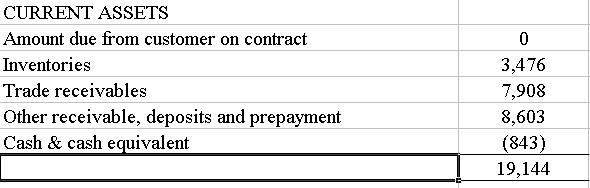
Look at the following snapshot of eB Capital's balance sheet obtained from its quarterly earnings yesterday.


See the piggy bank cash!!!

Think that is bad?

You haven't seen nothing yet babe!

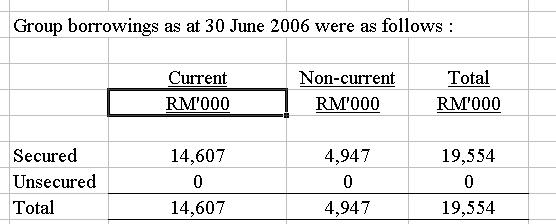
Look at the company's borrowings!

How?

See why I said that it's so insane that eB Capital is worth a whopping 30.6 million??????????????


Read more...

Huge Wall Street Bonuses. Do they deserve it?

Monday, August 14, 2006

CNN carried an article from Reuters on Wall Street bonuses set to soar

Here is the bottom-line mentioned by the article:

  • Bonuses for bankers will probably jump 25 percent, and equities traders may take home 20 percent to 25 percent more, according to the study by Johnson Associates Inc., a New York compensation consultant.
  • Investment banking bonuses often comprise the bulk of overall pay. A top banker or trader can receive seven- or even eight-figure bonuses after a stellar year.
  • "A lot of people are already making an enormous amount of money" before bonuses, Johnson said. "Now they can make twice as much of an enormous amount of money."
Do you ever wonder if these are really INSANE money being paid?

Do you reckon if these bankers really deserve so much money?

And oh, where and how do you reckon these investment bankers make their money from?

Care to share your views and opinions?

Read more...

DVM: Part IV

Thursday, August 10, 2006

Saw this article posted on theEdgeDaily.com

SC rejects DVM's placement
10 Aug 2006 8:37 PM
The Securities Commission (SC) has rejected DVM Technology Bhd's proposed placement of up to 35.2 million new shares of 10 sen each, representing up to 20% of its current paid-up capital

==> the SC rejected the exercise as "the SC is of the view that the proposed placement does not represent an adequate/comprehensive long-term solution to increase the company's operational profitability and liquidity".

Good job SC!!!

past blog postings on DVM:

DVM
DVM: Part II
DVM: Part III

Read more...

Is the US housing market slowing?

Wednesday, August 9, 2006

Is the US housing market slowing?


Well Chris Puplava has some great graphic illustrations to prove his point in his Market Wrap:


The slowing seen in housing is beginning to trickle through the economy as real GDP in the 2nd quarter was only 2.5%, with GDP revisions reducing nearly 25 basis points from annual real GDP growth during the nearly five-year expansion since 2001. Here are a few further sources of a slowing housing market. Home sales are off 10% from their peak last summer, unsold inventories have soared to a new record, construction spending is decelerating after peaking in early 2004, and the national median home price has decelerated sharply from the peak seen in 2005 (see charts below).


Figure 3


Source: Dismal Scientist


Figure 4


Source: Asha Bangalore, The Northern Trust Company
Daily Global Commentary 08.07.2006


Figure 5


Source: Dismal Scientist


Figure 6


Source: Dismal Scientist


Homebuilder optimism has been falling for nine straight months, with July’s reading of 39 marking the lowest level since December of 1991.


Figure 7


Source: Dismal Scientist

Read more...

Smoke And Mirrors!

Tuesday, August 8, 2006


Gary Dorsch of Sirchartsalot wrote an interesting piece: Central Bankers Operating behind "Smoke and Mirrors".

Here is a snippet of what he is saying:

The synchronized phase of monetary tightening by the world's three largest
central banks, the Federal Reserve, the Bank of Japan (BoJ), and the European
Central Bank (ECB), appears to be fizzling-out almost as soon as it started. The
Fed is widely expected to wind down its rate hike campaign on August 8th, less
than a month after the BoJ raised its overnight rate for the first time in five
years.

The Fed is moving to the sidelines to join the central banks of
Canada and Korea, which declined to raise their overnight loan rates last month.
That might encourage other central banks to keep their interest rates on hold. A
residual quarter-point rate hike by the BoJ to 0.50% in the fourth quarter, and
two quarter-point rate hikes by the ECB to 3.50% are expected, before the big-3
tightening spree flickers out.

Central bankers are utilizing a strategy
of "Smoke and Mirrors," mesmerizing the traders with baby-step rate hikes, but
falling far short of the levels needed to shrink their money supply. Whether the
central bank is printing money to maintain an artificially low exchange rate, or
flooding the banking system with money to peg an artificially low interest rate,
the net result is the same - monetary inflation.


Read more...

  © Blogger templates Newspaper by Ourblogtemplates.com 2008

Back to TOP